Grants and subsidies
Public funds
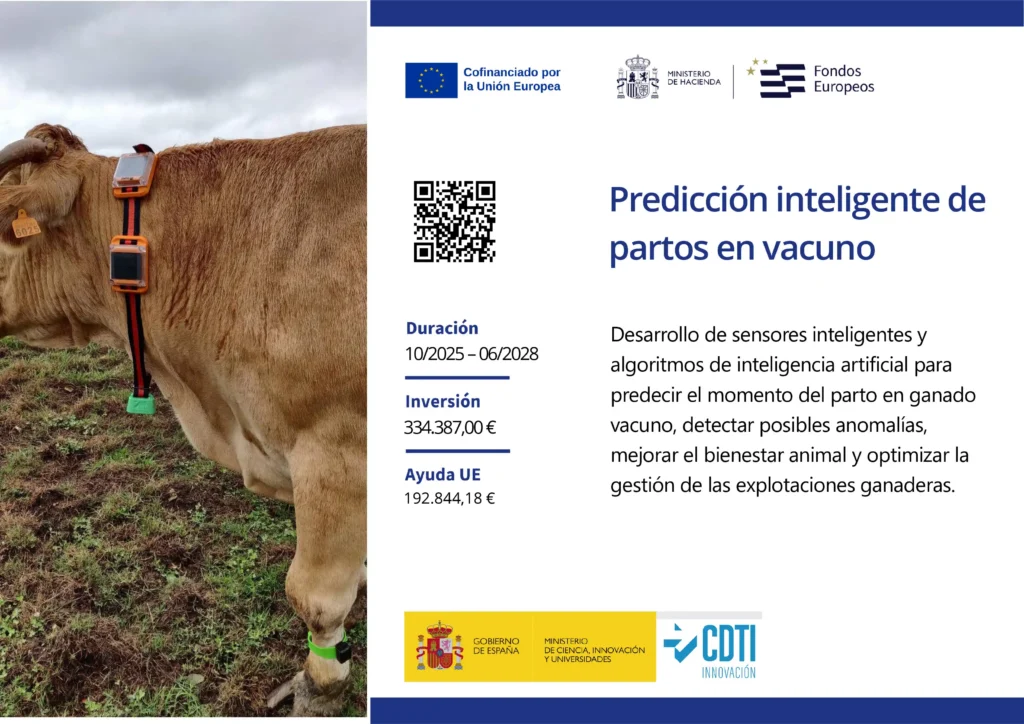
SMARTCALVING: artificial intelligence and advanced sensing to predict calving in cattle
SMARTCALVING is an R&D project led by Innogando to develop a new precision livestock farming solution focused on the early prediction of calving in cattle. The project is researching a new low-cost device, fitted to the animal’s leg, that connects via Bluetooth Low Energy to Innogando’s RUMI smart collars, creating a combined system that can provide new, high-value information for managing livestock farms.
➕ See more about the project
The main objective of the project is to improve the ability to anticipate calving by analysing postural changes, especially lying down and standing up, which are key indicators in the hours before birth. SMARTCALVING will also record and correlate other relevant variables, such as access to feeders and drinkers, movement inside the barn and the use of different areas, broadening our understanding of animal behaviour and reproductive management.
From a technological point of view, the project aims to move from early technology readiness levels (TRL 3-4) to TRL 7-8, that is, to the validation of a working prototype in real farm conditions. The project is aligned with the priorities of digitalisation, sustainability, animal welfare and competitiveness in the agri-livestock sector.
Innovation
The main innovation of SMARTCALVING is that it combines, in a single affordable solution, new postural and spatial variables with established metrics such as rumination, activity, feed intake and idle time. This data fusion will generate more accurate alerts, improve on-farm decision-making and reduce the risks associated with unattended or difficult calvings. The project also lays the foundations for a scalable technology ecosystem, with the potential to add new features related to animal welfare or the detection of metabolic disorders in the future.
Geographical scope
SMARTCALVING is being developed through international cooperation between Spain and Brazil. The Spanish participants are based in:
- Galicia: Innogando itself (lead company, responsible for the main technological development) and Medrar Innovation Office, which contributes to the data architecture, data pre-processing and the project’s international exploitation plan, the integration of the new device into the RUMI ecosystem and its future commercial exploitation.
- Catalonia: The Universitat Autònoma de Barcelona takes part in defining and validating the multimodal analysis algorithms applied to animal behaviour.
- Brazilian collaboration: The Universidade Tecnológica Federal do Paraná is responsible for validating the solution in intensive systems and in climate conditions different from those in Europe, strengthening its international applicability.
Project duration
Planned duration: 33 months, from October 2025 to June 2028.
Total EU funding allocated and total budget
Total project budget: €334,387.00.
Funding granted (CDTI grant co-financed by the ERDF): €192,844.18.
This project has received funding from CDTI with ERDF Funds 2021-2027 through its grants for R&D projects in international technological cooperation (INNOGLOBAL). Europa Se Siente.
RUMiA: the intelligence that ruminates on data and optimises livestock farming
Carried out by Innogando, funded under the IG408M-IA360 call for the development of artificial intelligence technologies applied to the livestock sector.
The initiative is co-financed by the Xunta de Galicia and the European Union – NextGenerationEU, under the Recovery, Transformation and Resilience Plan and the National Artificial Intelligence Strategy.
Emprendemento Plus
Innogando has been a beneficiary of the EMPRENDEMENTO PLUS 23-24 programme, a grant scheme of the Xunta de Galicia co-financed by the European Union. The programme supports investment and job creation in entrepreneurial initiatives.
Its aim is to consolidate business projects and encourage the creation of quality jobs.
AsopQRcel project
Aware of the importance of conserving and promoting the Porco Celta pig breed, the Xunta de Galicia has set up a grant scheme in collaboration with Asoporcel to support and promote the recovery, conservation and improvement of this native Galician breed. Through this programme, Porco Celta breeders can access financial support to improve their farms, promote the breed and preserve its genetic heritage.
Co-financed by the European Agricultural Fund for Rural Development (EAFRD) under the Galicia Rural Development Programme 2014-2020, for the period 2023-2025.
LaZteo project
The Galician dairy sector is looking to the future with this innovative project, which has two main goals: reducing the industry’s environmental impact in Galicia and speeding up its digitalisation.
INNOGANDO contributed to Milestone 2 by monitoring grazing with smart collars and GPS data.
Records from 15 animals were processed to analyse accuracy, spatial dispersion, daily movements and data coverage. Dot maps and heat maps show the areas where cattle spend the most time within each plot. This information is key to knowing where manure is concentrated and how to compensate for areas with a lower natural nutrient input. The data also helps to distinguish between areas of high and low grazing intensity, linking herd management to soil sustainability. The behaviour analysis showed patterns consistent with extensive systems, with feeding as the predominant activity and rumination within appropriate ranges. The collars have therefore proven to be a useful tool for improving animal welfare, agronomic management and the efficient application of slurry.
Innogando, together with Cooperativa Agraria Provincial de A Coruña SCG (Bico de Xeado), PORTO MUIÑOS S.L., ELMEGA, S.L., Alternative Fats and Proteins of Galicia S.L.U. (Alfaprogal) and Cartogalicia S.L., is working to implement Smart Farming and develop sustainable farming practices in Galician milk production.
This project is funded by the Galician Innovation Agency (Axencia Galega de Innovación) and the Galician Institute for Economic Promotion (Instituto Galego de Promoción Económica), with support from the European Regional Development Fund (ERDF) under the ERDF Galicia Programme 2021-2027.
Talento Empresa funds
Innogando has benefited from the Bonos Talento Empresa scheme to run short training projects. This scheme is co-financed by the European Union under the ESF+ Galicia 2021-2027 operational programme. Policy objective 4: “A more social and inclusive Europe through the implementation of the European Pillar of Social Rights”, so that employed workers taking part in the beneficiaries’ training projects can improve their skills.
Milkchain
Funded by the Axencia Galega de Innovación – Co-financed with ERDF funds.
All 3 annual phases have now been completed, achieving 100% of the objectives initially set out in the project:
➕ See more about the objectives achieved
- OG1. Research into the different enabling technologies applied to the value chain at its various critical points.
Companies involved: Leche Río, Innogando, Proymaes, Himikode (subcontracted: ITG) - OG2. Evaluation and improvement of these technologies through pilot validations with SMEs, research centres and the lead company.
Companies involved: Leche Río, Innogando, Proymaes, Himikode (subcontracted: ITG and USC) - OG3. Development of a comprehensive turnkey service to monitor the impact on the dairy value chain, including devices for continuous data capture, computer vision, artificial intelligence, machine learning and blockchain solutions for digital traceability certification, and an app that gives value to the processed data for end customers and distributors.
Companies involved: Leche Río, Innogando, Himikode (subcontracted: ITG)
More specifically:
We have developed computer vision models that detect, on each factory line, whether the labels on the bottles being filled match the order being run. Using a system of 2 cameras (one per production line), it is possible to carry out, in real time , both packaging quality checks and bottle counting. QR printing has also been integrated at the end of the pilot line.
All the data sources used to monitor milk qualityhave been integrated, and all the internal quality processes that factory staff carry out every day have been digitalised. In addition, the information to be stored on a block chain (Blockchain) has been designed, giving users farm-to-table traceability of the bottled milk.
We have built the final app for the different stakeholders (consumers, farms, industry), connected in real time to the monitoring platform.
All the software solutions implemented and integrated with other external systems (Ligal, Cegacol, Aemet) have been deployed on a Leche Río cloud system, making this information accessible 24/7. On this integrated monitoring platform we implemented prediction algorithms on the data, giving Leche Río a competitive advantage by allowing it to anticipate the factory’s needs.
Milktelligence
Milktelligence addresses the dairy sector’s need to improve productivity through data collection, sensors and the visualisation of key indicators for the dairy industry. The project will bring major advances in stock control on farms, help the company organise supply and link spoiled feed to production performance.
➕ See more about the project
This initiative aims to design, develop and validate a new collaborative platform for the primary and secondary sectors that, through purpose-built dashboards, enables agile decision-making based on maximising production performance, animal health and product quality.
Milktelligence is a strategic project promoted by the Galician Food Cluster (Clusaga), involving two technology companies (PS Vet DairyQuality and Innogando) and three food companies (GALACTEUM, Feiraco and Cooperativa Agraria Provincial de A Coruña), and funded under the support programme for Innovative Business Clusters of the Ministry of Industry, Trade and Tourism. Its overall goal is to boost competitiveness and the transition to digital leadership in the dairy sector.
Specific project objectives:
- Analyse the needs of dairy farms based on the strategy and market of the dairy industry.
- Define and install the sensors for data collection on the selected farms.
- Develop a platform for data collection and analytics.
- Set the relevant KPIs for dairy farms and build BI dashboards to visualise them.
- Validate the performance and applicability of the dashboards on dairy farms and correct any deviations.
This initiative aims to design, develop and validate a new collaborative platform for the primary and secondary sectors that enables agile decision-making through purpose-built dashboards.