
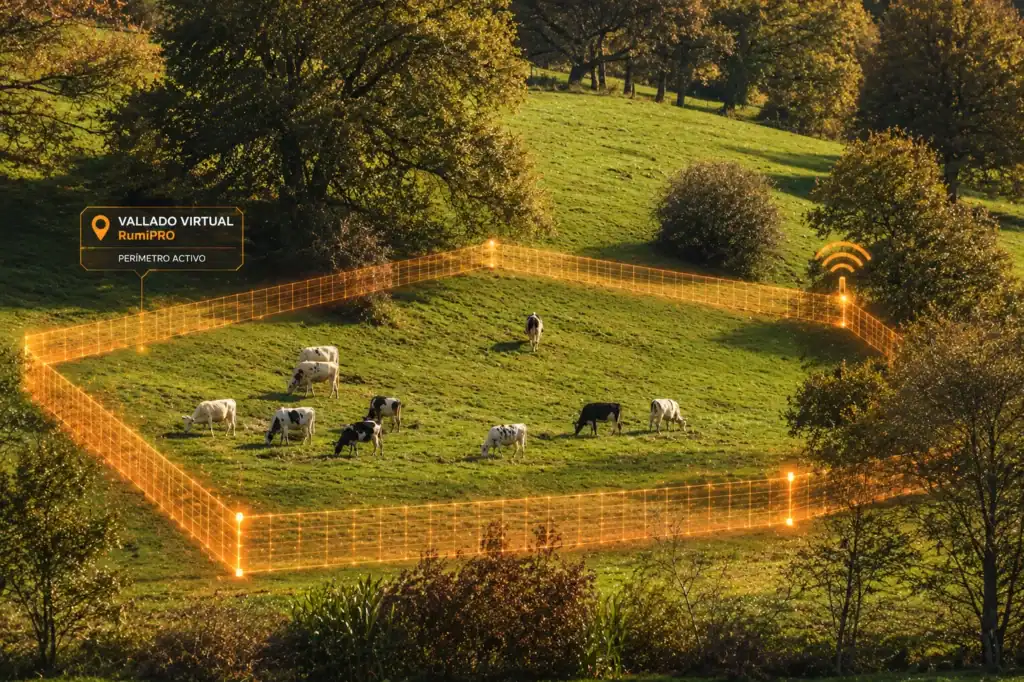
Installing and maintaining a physical fence on an extensive farm has a real cost: days of labour, posts, wire, repairs after storms, and the limitation of not being able to move the perimeter when you need to rotate pastures. For many farmers, the fence isn’t a solution — it’s one more problem.
What is virtual fencing for cattle?
Virtual fencing is a GPS-based containment system that needs no physical infrastructure. The farmer draws the field perimeter on a digital map in a mobile app, and a smart collar worn by each animal detects in real time when it gets close to that boundary.
No posts. No wires. Nothing to install on the ground.
The main difference from a traditional electric fence is that the perimeter is completely flexible: you can change it from your phone in minutes, without going to the field. This makes it easy, for example, to manage pasture rotation or to keep animals out of specific areas within the same field without putting up an inner fence.
How does virtual fencing work?
It is based on three elements: the app, the collar and the animal’s learning protocol.
The app lets you draw the perimeter on the map, assign animals to each enclosure and set exclusion zones within the field, such as ponds, crops or sensitive areas. Everything is managed from your phone, with no trips to the field.
The collar continuously monitors the animal’s GPS position. When the animal approaches the virtual boundary, the collar emits a sound cue that gradually increases in frequency. If the animal keeps moving forward instead of turning back, it receives a low-intensity electrical correction (0.2 J), similar to that of a conventional electric fence. If the animal turns back, the signal stops immediately.
Learning is what surprises people most when they first come across this technology: animals learn to respect the virtual perimeter within 4 to 7 days, following a progressive training protocol. First inside an existing physical enclosure, then gradually moving the virtual boundary inwards. Once the process is complete, the herd respects the perimeter on its own, without needing corrections.
What kind of farms is it right for?
Virtual fencing isn’t the right solution for everyone, and it’s important to understand this before deciding whether it suits your farm.
It works well for:
- Extensive farming with large fields, where installing a physical fence is expensive per kilometre.
- Rented or temporary land, where investing in permanent infrastructure isn’t worthwhile or possible.
- Farms that rotate pastures often and need the flexibility to move the perimeter at no extra cost.
- Fields with areas to keep animals out of (ponds, neighbouring crops, woodland) without putting up an inner fence.
It works less well for:
- Areas with dense tree cover or buildings, where GPS can lose accuracy. In these cases we recommend leaving at least 20 metres between the virtual boundary and any physical barrier.
- Herds with bulls, where some systems are still being validated.
- Winters with long periods of low sunlight if the collar relies on solar charging, although this can be monitored from the app.
How much does virtual fencing for cattle cost?
The price of a virtual fencing system depends mainly on three factors: the number of animals to equip, whether they already have a GPS collar or one needs to be bought, and the payment model (an upfront payment per collar plus an annual fee).
Unlike a physical fence, the cost of virtual fencing doesn’t grow in line with the size of the field. Virtually “fencing” a 500-hectare farm costs the same as a 50-hectare one, because the cost depends on the number of animals, not the perimeter.
For a fair comparison, it’s worth estimating the real cost of a physical fence on an average extensive farm. Installing a livestock or game fence, including posts, mesh and labour, can easily exceed €3,000–5,000 per kilometre on uneven ground. On top of that come annual maintenance and repairs after storms or damage caused by wildlife. On farms with several kilometres of perimeter, the investment is very significant.
Virtual fencing removes that infrastructure cost and turns it into a cost per animal: an upfront payment per collar and an annual fee.
Rumi PRO, Innogando’s collar with virtual fencing, will be available in spring 2027 from €22.80 per collar per year. The exact price depends on the number of animals, so the easiest thing is to ask for a quote for your farm.
Want to know if virtual fencing is right for your farm?
At Innogando we assess each farm before recommending a solution. If you’re not sure whether the system would work on your land or you’d like to know the price for your number of animals, get in touch and we’ll prepare a no-obligation quote.